
At Saturday Light Brigade Radio, young people lead live broadcasts, choose the topics they care about, and engage in thoughtful conversations about history, community, their schools and their own lives.
By Karen Price
The main floor of the Children’s Museum of Pittsburgh was filled with the sound of youthful exuberance on a bitterly cold Martin Luther King, Jr. Day as children with the day off from school delighted in the chance to explore and have fun.
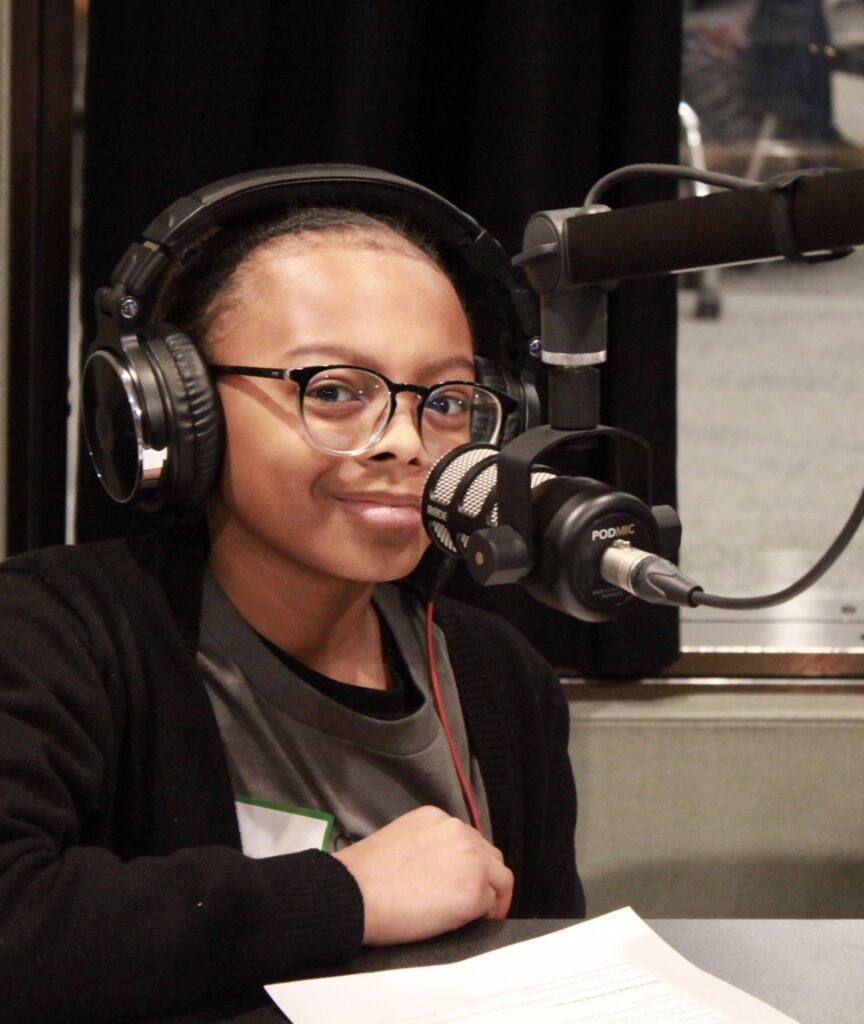
Downstairs, however, a different kind of energy filled the space. A group of middle and high school students sat deep in conversation inside the state-of-the-art Saturday Light Brigade Radio studio, gathered for the annual Streaming Justice live broadcast honoring the legacy of Dr. King. The four students who hosted the first hour of live content ranged in age from 11 to 17, and they’d chosen their own topics to discuss within the day’s theme of Civil Rights: Past, Present and Future.
The opening segment focused on Dr. King and his legacy.
“He got arrested 29 times, but guess what?” said 11-year-old Nathanael Davidson, who attends nearby Manchester Academic Charter School on Pittsburgh’s North Side. “He did not give up.”
SLB Radio’s model emphasizes prioritizing youth voices and choice in what to explore in their out-of-school-time programming and the nonprofit has been part of PA Humanities’ Youth-Led Humanities cohort since 2024.
Saturday Light Brigade Radio began as a show by the same name founded in 1978 by then-17-year-old Larry Berger, now the executive director. Today, the Saturday Light Brigade is one of the longest-running public radio programs in the country, and SLB Radio’s Youth Express programming includes student journalism, podcasting and live broadcasting as part of afterschool programs and special events. Through the programming, young people build skills including civil deliberation, collaboration, asking thoughtful questions and active listening.

Youth-Led Humanities supports weekly live broadcasts, which had been missing from SLB Radio’s regular slate of programming until last year.
“One thing that felt like it ought to be part of what we do but hadn’t been part of our work since the pandemic was live programming led entirely by youth and hosted entirely by youth,” youth media center manager Jozef Kukula said.
“Youth Express Live” is open to students in grades six through 12. Five dedicated young people hosted the program, which aired every Wednesday, in its first season. They interviewed guests, including young musicians, artists and entrepreneurs, and talked about what was happening in their own lives, schools and communities. They never missed a week.
“They had people listening who they’d never met before, so they started to get the idea that you’re talking to people who would otherwise not hear your voice, not hear your perspective, and so they got excited by that,” said Kukula, adding that this year they’ve expanded live programming to multiple nights per week, with plans to add more.
“I enjoyed the self-creation of it. That was my favorite part, the creative freedom. When you’re getting told what to do or what to say you lose that spark in it, the natural laughter or whatever might arise out of the conversation.”
Dawn Martin, 17
Alex Bennett, one of the youth educators at SLB Media, has a background in radio from the University of Pittsburgh and works with students who want to become live hosts to learn both the technical and interpersonal tools they’ll need. She’s drawn to the medium because it allows people to connect without the biases that can come with appearance. For young people growing up in a video-saturated world, audio can feel especially freeing.
“You see the kids start to put themselves out there more, even if they think their opinion is going to be silly, or different,” she said.

Waylon Heikinen is an eighth grader at Ingomar Middle School in Franklin Park in the northern suburbs of PIttsburgh. He participates in afterschool programming as well as summer camps and workshops at SLB Media and appreciates the technical skills he’s learning about media production. He also enjoys having the chance to be in conversation with kids from different areas of Pittsburgh in a space where he’s comfortable expressing himself.
“I think it’s nice to know what other kids my age are going through, and their experiences and how they feel, where they live and how it’s different from where I live,” he said.
Heikinen was also a part of Streaming Justice, one of two special events SLB Radio holds throughout the year where any student interested in being part of the live broadcast can join in whether or not they regularly attend programming. The students all meet that day for the first time, and each group of hosts decides what they want to discuss during their hour of broadcasting in the time before going on the air.
Dawn Martin, 17, was part of the first group with Davidson. In addition to Dr. King, the students chose to discuss Harriett Tubman and her role in history, modern civics, and stereotypes in sports. Having the opportunity to decide what they talked about was “the most important,” she said.
“I enjoyed the self-creation of it,” she said. “That was my favorite part, the creative freedom. When you have creative freedom you want to talk about what you’re talking about. When you’re getting told what to do or what to say you lose that spark in it, the natural laughter or whatever might arise out of the conversation.”

That sense of ownership and creative freedom is central to PA Humanities’ youth-centered approach, which recognizes that young people engage most deeply when they feel seen, trusted, and capable of shaping the conversation.
Davidson’s mother, Tonita, was on hand for the broadcast. She didn’t know until they arrived, she said, that Nathanael would be the youngest in his group. She appreciated the older kids, including Martin, helping him when he got nervous and supporting him in moving his ideas forward. He can be shy, she said, but she’s seen his confidence grow since coming to the SLB Radio afterschool program.
“This gives kids the confidence to speak on things that happen to them personally and realize that how they feel matters just as what somebody else feels matters, and it gives them the opportunity to express that,” she said. “It also allows other kids listening to say, ‘Hold on, we as children know things and we have a voice as well.’ I think there are some negative stereotypes about kids this age, that all they want to do is TikTok videos and challenges, but this shows that no, we do that because it’s fun, but we also have thoughts and feelings about what’s happening in our world.”
Nathanael said after the broadcast that he was nervous at first, but got excited when the show started. Most of all, he wanted to share what he knew about Martin Luther King, Jr.
“He was such an important man because he was the youngest man to receive a Nobel Peace Prize,” he said. “Thirty-five years old. I hope (the kids listening) have learned that there should be equal rights everywhere.”
![[color - dark bg] PA SHARP FINAL FILES DB 72dpi](https://pahumanities.org/uploads/files/elementor/thumbs/color-dark-bg-PA-SHARP-FINAL-FILES-DB-72dpi-phgl7aimtfdpzt2rscvl43ksfv3asbbls19lsvuacw.jpg "[color – dark bg] PA SHARP FINAL FILES DB 72dpi")