How storytelling shapes PA Humanities’ approach to research and support for the state’s cultural sector
By Karen Price
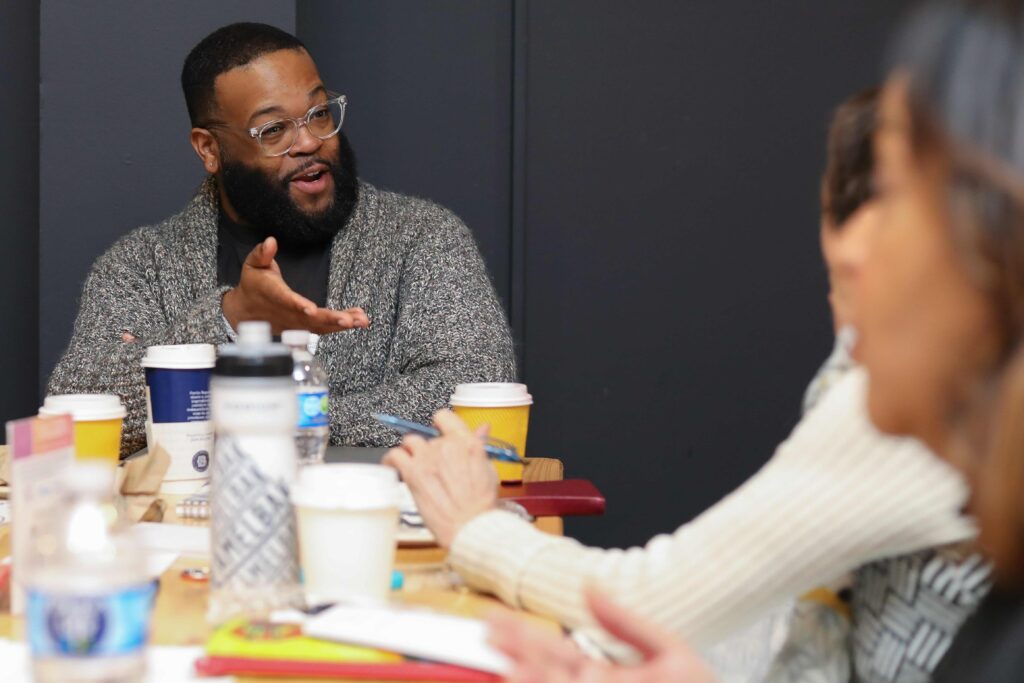
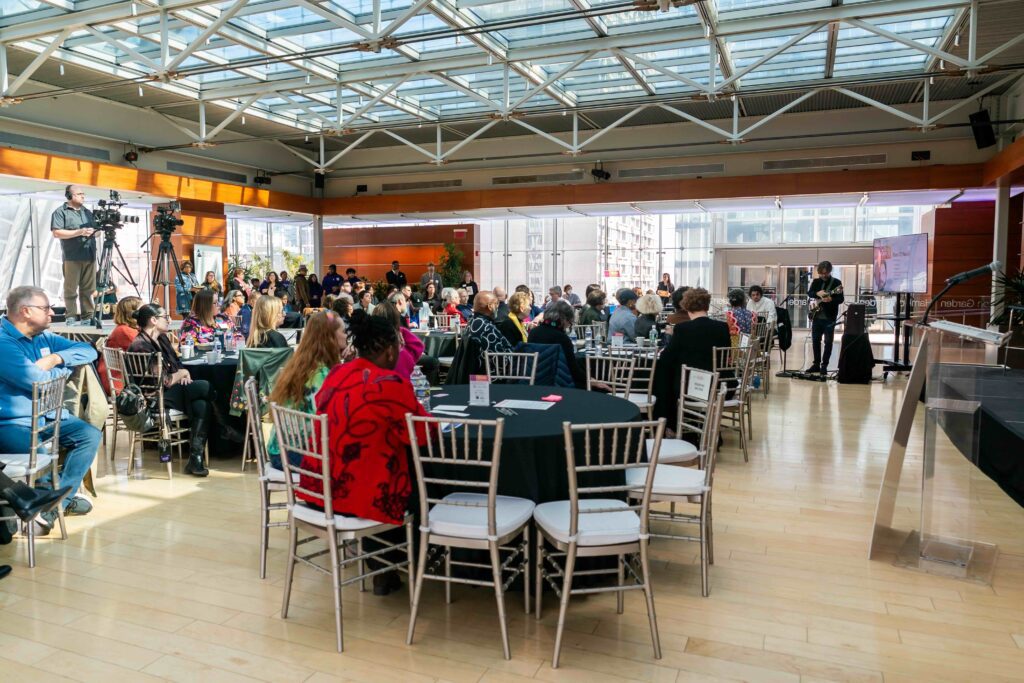
Throughout Philadelphia, diverse groups of people connected by their passion and love for the arts, culture and the humanities, gathered earlier this year for a series of conversations.
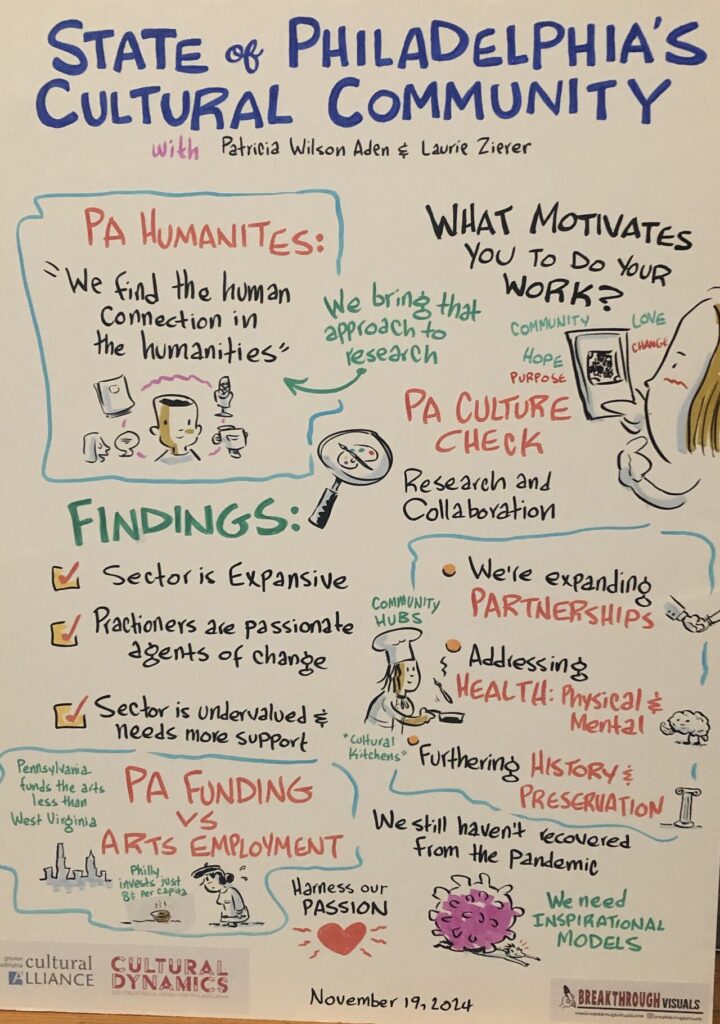
They met as part of a research project from partners PA Humanities, Drexel University and the Greater Philadelphia Cultural Alliance (GPCA) to collect data that will inform cultural policy and city-wide planning, and to develop a process to continue gathering input from the community as part of Cultural Dynamics: Co-Creating a Vision for Philadelphia.
But researchers weren’t just looking for numbers or statistics.
They wanted stories.
“Stories aren’t window dressing,” PA Humanities executive director Laurier Zierer said. “Stories reveal the nuance and the complexity of issues. A data point is a prompt to ask and explore and be curious and to ask another question. That’s a humanities approach to life.”
People often think of the humanities in the academic sense – discussions of philosophy or literature in a college lecture hall or a visit to a historical site or museum. But PA Humanities has always taken a broader view, especially when it comes to people and the value of their stories. And while it’s highly unusual for a state humanities council to get involved in research projects, much less help design them, PA Humanities has embraced the opportunity to champion the use of stories as data. Cultural Dynamics is the latest chapter in the organization’s ongoing effort to understand and support Pennsylvania’s creative and cultural ecosystem.
Zierer saw the potential in participatory research in the early days of PA Humanities’ Chester Made project as well as their partnership with Community Heart & Soul. Both initiatives are based on storygathering: getting out and talking to the people who live, work and play in the community. In Chester, those stories helped to map the arts and culture district.
In the PA Heart & Soul process, residents drive the initiative by asking neighbors what they love about their community, why, and what they want for its future. Their stories become the data from which the town’s values emerge and become guideposts, and give rise to plans for action where citizens build the future they want together.
It just made sense to apply those same principals to research into the state’s cultural sector.
“This is what we do,” Zierer said. “We work with communities to co-create a platform, with partners, for folks to come together to envision what they want to see in their communities to strengthen them for the future. That is our bread and butter of the work that we do. For me it was a very easy step into doing participatory research because we had already been doing it with our programs. We’re now bringing that participatory approach to what has been a big data approach to cultural policy and creating the momentum that the participants themselves take on what has surfaced as values and action plans to move them forward.”
This type of mixed methodology of collecting traditional data in addition to stories and emphasis on storygathering is now intrinsic to PA Humanities in its research. It’s a vital part of the organization’s partnerships, including those that have produced the expansive PA Humanities Discovery Project, PA Culture Check, and Cultural Dynamics.
“Stories aren’t window dressing. Stories reveal the nuance and the complexity of issues.”
PA Humanities executive director Laurie Zierer
For Cultural Dynamics, the research team reached out to musicians, visual artists, writers, entrepreneurs, nonprofit workers, filmmakers, documentarians and others spanning a broad spectrum of creative, cultural and humanities workers and allies. They invited lifelong residents, newcomers, young, old, of different backgrounds, ethnicities, orientations, identities and income levels.
They asked questions including:
- What aspects of being part of the Philadelphia creative and humanities community strengthens your work?
- Who supports you, and who are your best collaborators?
- What should Philadelphia’s arts, culture, and humanities sector look like in 10 years?
- What do you want to retain?
- What do you want to build?
- If you could wave a magic wand, what’s one thing you would change to strengthen Philly’s arts and culture experience?
For those who think of traditional data-informed research as being heavy on numbers and quantitative inquiry, the stories that come from questions such as these might not seem like a reliable source of information. But Drexel University’s Antoinette Westphal College of Media Arts & Design researchers Andrew Zitcer and Julie Goodman explain that the data collected is both reliable and meaningful.
“One of the things that’s really important for us is explaining not only to our practitioner colleagues but also to academics that story-based research is rigorous and it is evidence and it can be systematically reviewed, critiqued and synthesized,” Zitcer said. “In the case of the Discovery Project, we had over 15,000 data points marked in the transcripts of these thousands of documents. Through that coding you can get a story. When you ask for statistics, or you ask for a map, you’re asking for a different tool, and all of those tools really reinforce each other. If somebody wanted to know where their grandfather came from, you wouldn’t just put a map in front of them. You’d say, here’s the story of this place and here’s how he got here.”
Part of the process at Drexel, Goodman said, is having multiple people reading through stories and transcripts, capturing, notating and discussing what they’re seeing, and then going back to the public and testing their analysis with the people who gave them the information to make sure they got it right.
Continuing those conversations and asking “did we get this right,” as was the case with the Discovery Project and now Cultural Dynamics, is the key to bridging research and policy making.
“Where does the impetus come from for what a policy needs to be?” Goodman said. “Is it top down, where someone says ‘This is what I see happening,’ or is it bottom up, where these are people’s experiences? And what does that say about what else might be needed or how it can be better supported or differently supported than it is now? And it’s that latter approach that we’re trying to take with this.”
One of the things that excites Goodman the most from an academic and a community perspective about how this data might influence citywide planning or future arts and cultural policies in Philadelphia is the opportunity to surface answers that people who aren’t in practice couldn’t come up with on their own.
“One of the themes that’s coming out of Cultural Dynamics, for example, is about spaces and places where people are connecting with one another or available to use for creative production and activity,” she said. “That’s information we got directly from the people experiencing those challenges.”
“If somebody wanted to know where their grandfather came from, you wouldn’t just put a map in front of them. You’d say, here’s the story of this place and here’s how he got here.”
Drexel University researcher Andrew Zitcer
And if the goal is to change the circumstances of the cultural workers, Zitcer said, we have to change the structure that determines what is possible so that they don’t come back years from now and find nothing’s changed.
“To frame these things in light of experience but also backed by research, we can begin to say that if we’re really serious we need to make these recommendations in this way, and hold decision makers accountable to the people who’ve entrusted us with these stories and ideas,” he said.
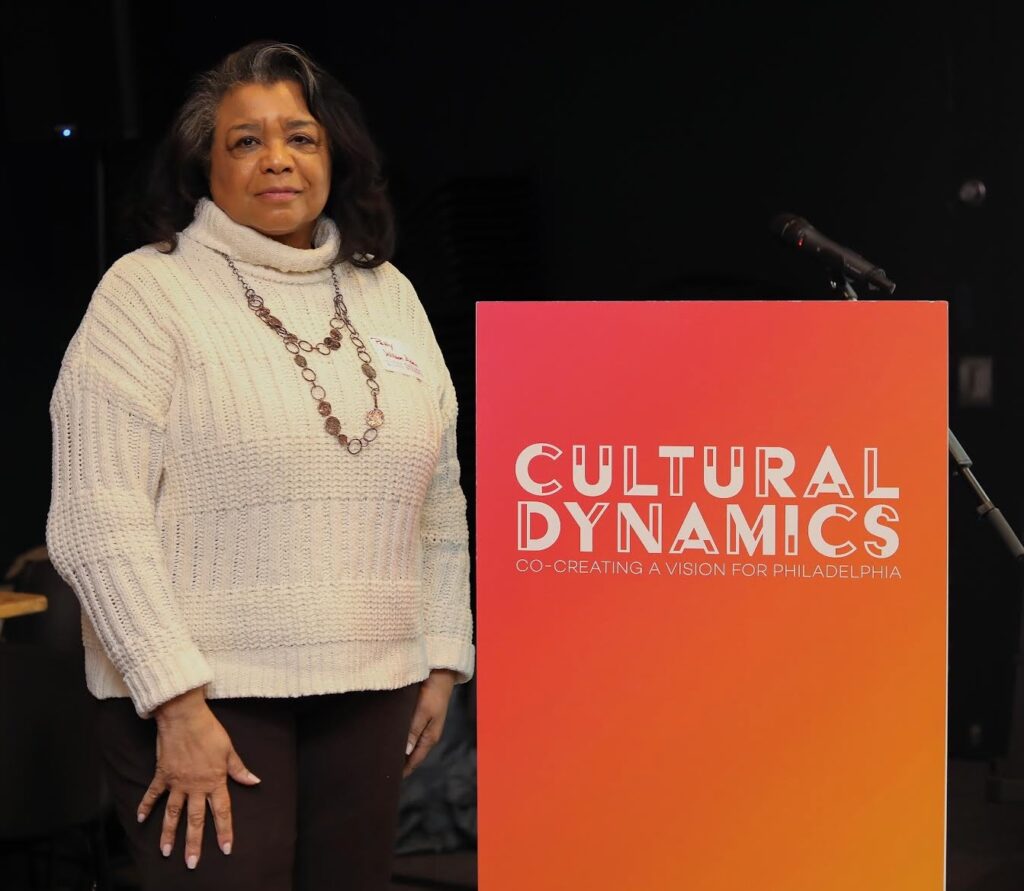
Patricia Wilson Aden is the President and CEO of the Greater Philadelphia Cultural Alliance, the region’s foremost arts and culture advocacy, research and marketing organization. They have a long history of research that has, over the course of decades, generated data-rich, statistic-driven information.
What they’re finding in their partnership with PA Humanities and Drexel is that bringing the human narrative to their research adds dimension to their findings. The arts and humanities community, Wilson Aden said, values narrative and believes in giving voice to numbers, and adding participatory methodology and storytelling to the research distinguishes their work from that of other sources.
“It adds an important and distinctive dimension to the work that we do that is appreciated by funders, by elected officials, and by key audiences,” said Wilson Aden, who also serves on PA Humanities’ board of directors. “We’ve discovered that it’s particularly compelling when we have that narrative and that human voice.”
PA Humanities, GPCA and Drexel researchers are in the process of taking the data gathered at a series of community conversations earlier this year and creating a report that will help inform and shape a cultural plan for the city of Philadelphia and a framework for supporting the city’s arts and culture community. Much like the action plans that grow from PA Humanities’ Heart & Soul process, this won’t be a document designed to sit on a planning office shelf collecting dust. It is designed to be a dynamic guidepost that will allow funders to feel the value of their investments, and for elected officials to see beyond mere numbers to hear the voices that make up their constituency and their neighborhoods.
Combining stories with statistics will allow them to engage the audiences they need to engage in order to make impactful policy a reality, Wilson Aden said.
“There are some elected officials that are still very interested in the numbers,” she said. “We’re finding others that are enthralled and engaged at a new level with the narrative. What we believe is not only that the most effective approach but also the most accurate approach is a combination of the two. And that’s where this methodology comes in. We provide solid data that gives us credibility, but we are also very mindful that we are telling a human story, and we are trying to make real and personal connections.”
Beyond impacting policy, Zierer said, this type of people-first research has the potential to lift the power of community to create their own change.
“For PA Humanities, this is a huge opportunity for us to lift our research, like we do with Heart & Soul, and the power of community building as part of that research process for people to take on the findings and move them forward,” Zierer said.
Whether through the Discovery Project, Cultural Dynamics or future research, Zierer hopes to continue to champion the power of the community and people themselves to take on challenges. Through Heart & Soul in particular, PA Humanities knows that oftentimes solutions are hyper local and hyper individual, and those solutions can sometimes lead to the greatest changes.
“We can have a transformational role because we ask big questions about how people themselves can take on challenges,” she said. “We don’t ask first what government can do for us, or funders, or businesses. We look to answers within the people themselves and their collective values to make those changes. Policy doesn’t have to be something that someone else does.”

![[color - dark bg] PA SHARP FINAL FILES DB 72dpi](https://pahumanities.org/uploads/files/elementor/thumbs/color-dark-bg-PA-SHARP-FINAL-FILES-DB-72dpi-phgl7aimtfdpzt2rscvl43ksfv3asbbls19lsvuacw.jpg "[color – dark bg] PA SHARP FINAL FILES DB 72dpi")